
📌 Key Takeaways
Grade confusion costs SME converters money in over-specified materials and lost customers from under-specified failures.
- Kraft Linerboard Demands Strategic Deployment: Virgin fiber KLB (115–440 g/m²) delivers superior ring crush and burst strength but commands premium pricing, making it essential only for heavy-duty export cartons and extreme stacking applications where performance justifies the 15–25% cost premium over Testliner.
- Testliner Fills the Middle Ground: Recycled-content Testliner (115–300 g/m²) provides adequate strength for domestic shipments and e-commerce parcels at medium cost, allowing converters to reserve expensive KLB for jobs that genuinely require it rather than defaulting to premium grades out of caution.
- Fluting Performance Determines Box Integrity: The corrugated medium carries compressive load and moisture resistance, with semi-chemical fluting (112–180 g/m²) outperforming standard recycled options in humid or cold-chain conditions—treating fluting as an afterthought causes surprise failures even when liners look strong.
- A Plant-Specific Grade Guide Enables Agile Sourcing: Documenting preferred grade combinations for your top 10–15 SKUs, including acceptable substitutions and failure thresholds, creates a shared language across sales, operations, and procurement that prevents over-specification waste and makes alternative supplier evaluation faster during supply disruptions.
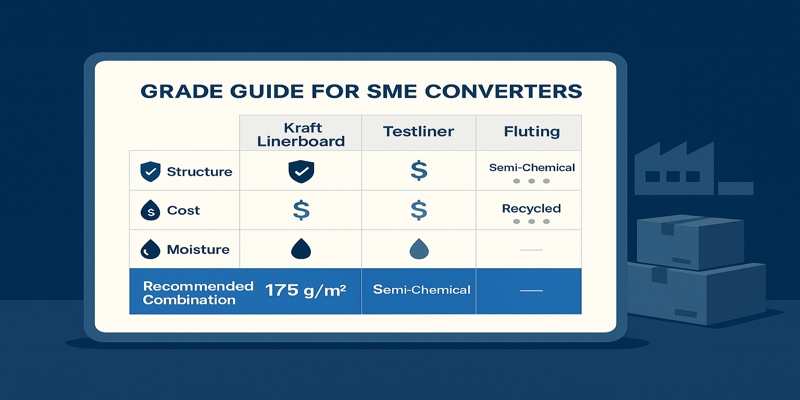
- The Comparison Table Converts Experience into Standards: A single-page reference comparing grammage ranges, applications, strength profiles, and cost bands for KLB, Testliner, recycled fluting, semi-chemical fluting, and white-top liner transforms scattered tribal knowledge into repeatable decisions that protect margins without sacrificing performance.
Clear grade specifications prevent MOQ traps and inventory bloat while enabling confident supplier negotiations.
SME packaging converter owners and procurement managers will find a systematic framework here, preparing them for the detailed grade-to-application mapping and comparison table that follows.
Kraft paper grades determine whether your corrugated boxes hold up in transit or collapse under pressure. For SME converters, matching the right grade to each application controls waste, protects margins, and prevents costly failures. This guide compares kraft linerboard, testliner, and fluting—the three core grades—and provides a practical comparison table you can adapt into your plant’s internal standard.
Why Grade Choice Makes or Breaks SME Converters
A mid-sized converter running tight margins doesn’t have room for trial-and-error grade selection. Over-specify your liner, and you’re burning cash on strength you don’t need. Under-specify your fluting, and boxes fail in the warehouse, triggering complaints and lost accounts.
The stakes are particularly high when MOQs force you to commit to large volumes before you’ve validated performance. Choosing the right paper grade is critical for production efficiency and product quality. Without a clear internal framework, grade decisions become inconsistent—sales promises one thing, operations orders another, and procurement scrambles to reconcile the mismatch.
This article walks you through the main kraft paper grades, shows how each one’s technical properties map to real applications, and delivers a reusable comparison table that turns grade selection from guesswork into a repeatable process.
The Role of Kraft Paper Grades in Corrugated Performance
A “grade” in kraft paper refers to the combination of basis weight (measured in g/m²), strength characteristics, surface quality, and fiber composition—whether virgin kraft or recycled content. Industry standards and test methods for linerboard and corrugating medium, as established by TAPPI (Technical Association of the Pulp and Paper Industry), describe parameters such as basis weight, ring crush, burst strength, and moisture behavior.
A corrugated board is a sandwich: two liners (the outer faces) hold a fluted medium (the structural core). The liner protects the contents and provides the print surface. The fluting absorbs impact and gives the board its compression strength. If either component is mismatched to the application, the entire structure underperforms.
Most SME converters work with three primary grades:
- Kraft Linerboard (KLB): Virgin fiber, highest strength, premium cost
- Testliner: Recycled content, moderate strength, lower cost
- Fluting (Medium): The corrugated core, available in semi-chemical or recycled variants
Understanding how these grades differ—and when to deploy each—is the foundation of smart sourcing.
Key Grades SME Converters Work With
Kraft Linerboard (KLB)
Kraft Linerboard offers superior strength but at a higher cost compared to Testliner, so converters must balance performance needs with budget constraints. KLB is made from virgin pulp, giving it excellent tensile strength and burst resistance.
Typical specifications:
- Basis weight: 115–440 g/m² (common transport packaging typically uses 115–200 g/m², with higher weights for specialized industrial applications)
- Burst strength and ring crush strength: High relative to recycled alternatives at similar grammage, as defined by TAPPI testing standards
- Surface: Smooth enough for quality printing
- Applications: Export cartons, heavy stacking loads, premium branded packaging
- Relative cost: High
When your customer ships electronics overseas or stacks pallets eight boxes high, KLB is often the only safe choice. The fiber quality ensures consistent runnability on your corrugator, reducing jams and setup time.
Testliner
Testliner uses recycled fiber, which lowers material cost but sacrifices some strength and surface consistency. For many applications—especially domestic shipments or lighter loads—Testliner performs well enough.
Typical specifications:
- Basis weight: 115–300 g/m² (often overlaps with KLB ranges, allowing direct cost-performance comparisons)
- Ring crush and burst values: Lower than comparable KLB, but adequate for non-extreme stacking and transit when board design is appropriate
- Surface: Adequate for basic printing; not ideal for fine detail
- Applications: Light retail packaging, e-commerce parcels, display boxes
- Relative cost: Medium
The trade-off is straightforward: if the box doesn’t face extreme stacking or moisture exposure, Testliner saves money without compromising performance. Many converters use Testliner for the inner liner and KLB for the outer face, balancing cost and strength.
Fluting (Corrugating Medium)
Fluting is the structural backbone of corrugated board and needs appropriate moisture resistance; sourcing quality fluting is essential for box integrity, not just an afterthought. The fluted layer absorbs impacts and provides compression strength. Fluting performance is structurally assessed primarily through the Corrugated Medium Test (CMT), the recognized industry standard defined by TAPPI.
Typical specifications:
- Basis weight: 90–180 g/m² (varies with flute profile: A, B, C, E)
- Composition: Semi-chemical (stronger, 112–180 g/m²) or 100% recycled (more economical, 90–140 g/m²)
- Moisture resistance: Critical for cold-chain or humid storage
- Strength profile: Designed for crush resistance within the flute structure
- Applications: All corrugated structures; flute profile varies by application
- Relative cost: Low to Medium (recycled), Medium to High (semi-chemical)
Poor fluting choices show up fast: boxes that look fine when empty collapse under load, or humidity causes the flute to soften and lose shape. Always match fluting quality to the application’s worst-case environment.
Other Useful Variants
White-top liner (140–300 g/m²) combines a bleached or coated surface layer for enhanced graphics with an economical recycled base. Use it when print quality and presentation matter for retail-ready or shelf packaging.
Semi-chemical fluting (112–180 g/m²) provides improved crush and moisture performance compared with fully recycled medium, at a higher cost band. Reserve it for demanding loads, humid routes, or cold-chain applications where standard fluting creates risk.
These variants should appear in your internal guide as “special-purpose” options, not default grades.
Matching Grade to Application: Common Scenarios
Let’s map typical jobs to suitable grade combinations. These scenarios assume standard corrugated board construction (single-wall, B-flute or C-flute).
Heavy-duty export cartons (automotive parts, machinery components):
- Outer liner: KLB 150–200 g/m²
- Inner liner: KLB 125–150 g/m² or Testliner Grade 1
- Fluting: Semi-chemical medium 120–140 g/m²
- Why: Maximum stacking strength, moisture resistance for ocean freight
E-commerce and parcel shipments (consumer goods, light electronics):
- Outer liner: Testliner Grade 2 or KLB 125 g/m²
- Inner liner: Testliner Grade 3
- Fluting: Recycled medium 100–110 g/m²
- Why: Adequate protection for single-box shipments, cost-effective
Light retail or display packaging (shelf-ready packaging, point-of-sale displays):
- Outer liner: White-top testliner 140–200 g/m² or coated KLB (for print quality)
- Inner liner: Testliner Grade 3–4
- Fluting: Recycled E-flute (thin profile for compact boxes)
- Why: Print surface matters more than extreme strength
Moisture-exposed or cold-chain use (fresh produce, refrigerated goods):
- Outer liner: KLB 150–175 g/m² with wax or coating
- Inner liner: KLB 125 g/m²
- Fluting: Semi-chemical medium 120–140 g/m² with moisture-resistant sizing
- Why: Humidity degrades recycled fiber quickly; virgin kraft holds up better
These combinations are starting points, not absolutes. Your actual choices depend on your equipment’s capabilities, customer requirements, and the specific failure modes you need to prevent.
The Paper Grade Comparison Table
Below is the Paper Grade Comparison Table—the core reusable asset of this guide. This table synthesizes the grades covered above into a single-page reference you can screenshot, print, and keep near your RFQ templates or corrugator control panel. The paper grade comparison table enables repeatable, plant-wide grade selection decisions by standardizing how your team evaluates each option.
| Grade | Typical Grammage Range | Typical Applications | Strength Profile | Print Quality | Relative Cost |
| Kraft Linerboard (KLB) | 115–440 g/m² | Export cartons, heavy stacking, premium packaging | High burst and ring crush strength | Excellent — smooth surface | High |
| Testliner (Grade 1–4) | 115–300 g/m² | Domestic shipments, retail boxes, e-commerce | Moderate (varies by grade) | Fair to good | Medium |
| Fluting (Recycled) | 90–140 g/m² | Cost-sensitive applications with lower load | Moderate compression strength | N/A (not visible) | Low – Medium |
| Fluting (Semi-Chemical) | 112–180 g/m² | Demanding loads, humid or cold-chain routes | High crush & moisture resilience | N/A (not visible) | Medium – High |
| White-Top Liner | 140–300 g/m² | Retail-ready packaging, high-quality print | Varies by construction | Enhanced graphic quality | Medium – High |
How to use this table:
- Identify the job’s primary requirement: strength, print quality, or cost.
- Cross-reference the typical application column to find candidate grades.
- Check the grammage range against your corrugator’s setup specifications.
- Verify the cost band aligns with your customer’s budget.
This table doesn’t replace supplier datasheets, but it gives you a common vocabulary for internal discussions and RFQ specifications. When your sales team promises a “premium carton,” everyone now knows that means KLB outer + semi-chemical fluting—not Testliner Grade 3.
Turning the Table into Your Internal Grade Guide
The comparison table becomes valuable when you adapt it to your specific operation. Here’s a step-by-step method for building an internal grade guide that reduces confusion between sales, operations, and procurement:
Step 1: List your top 10–15 SKUs or customer applications. Pull data from your order history. Focus on recurring jobs, not one-offs.
Step 2: Map each SKU (Stock Keeping Unit) to a preferred grade combination. Use the comparison table as your starting point. For example, if you regularly produce boxes for a furniture manufacturer, you might specify:
- SKU: FurnitureCo Standard Carton
- Preferred: KLB 150 g/m² (outer) / Testliner Grade 2 (inner) / Semi-chemical fluting 120 g/m²
Step 3: Add acceptable substitutions. Supply disruptions happen. Document which grades can substitute under cash or availability constraints:
- If KLB 150 unavailable: Accept KLB 140–160 g/m² or upgrade to 175 g/m² with customer approval
- If semi-chemical fluting unavailable: Substitute 100% recycled fluting only for non-export applications
Step 4: Include failure thresholds and operational notes. Note the minimum acceptable specs and any comments from the corrugator crews about runnability, warp tendencies, or print behavior. For the furniture carton, you might write: “Never drop below Testliner Grade 2 for outer liner—Grade 3 fails at customer’s stacking height.”
Step 5: Review and update regularly. Revisit the guide in production meetings, updating it as new jobs, failures, or learnings appear. As you gather data on actual box performance, adjust the guide. If a grade combination consistently over-performs, you may downgrade slightly to save cost. If failures occur, upgrade the spec and document why.
This internal guide becomes your single source of truth. Sales quotes from it, operations orders from it, and procurement sources from it. The result: fewer surprises, less rework, and margins that hold steady even when raw material prices fluctuate.
For more context on how grade choices interact with cash flow and payment terms, see this beginner’s cash conversion cycle map for kraft paper buyers.
Common Pitfalls When Choosing Kraft Paper Grades
Even experienced converters fall into predictable traps. The comparison table and internal guide help you avoid these five mistakes:
Pitfall 1: Copying large-mill or large-customer specs without checking fit for SME scale.
Big customers often specify grades optimized for their specific supply chains or compliance requirements. Those specs may be overkill for your operation. A multinational might demand KLB 175 g/m² for a product that would perform fine in KLB 150 g/m² at your scale. Run pilot tests with slightly lower grades before committing to premium specs.
Pitfall 2: Over-specifying liner “just to be safe” and eroding margin.
The instinct to add a safety buffer is understandable, but it accumulates fast. If you habitually upgrade from Testliner Grade 2 to KLB 125 g/m² on jobs that don’t require it, you’re sacrificing 15–25% in material cost. The table forces you to justify each upgrade with evidence, not anxiety.
Pitfall 3: Under-specifying fluting, leading to surprise failures.
Because fluting is hidden inside the board, it’s tempting to cheap out. This backfires when boxes collapse during stacking or when humidity softens recycled fluting in cold storage. Fluting is the structural backbone of corrugated boards and provides moisture-resistant performance—treat it as a critical component, not a cost-cutting opportunity.
Pitfall 4: Ignoring humidity or storage conditions when picking fluting.
A grade that works perfectly in a climate-controlled warehouse can fail in outdoor storage or refrigerated transport. If your customer’s supply chain includes moisture exposure, specify semi-chemical fluting with proper sizing. Recycled fluting degrades quickly when wet. Leaving paper or finished boxes in damp areas can undermine even good grade choices.
Pitfall 5: Making ad-hoc substitutions without documentation.
During shortages, converters sometimes substitute grades informally. Without updating the internal guide, these changes create inconsistent performance and confusion. Document every substitution, note the outcome, and update your standard if the change proves successful.
How Better Grade Choices Support Agile Sourcing
Clear internal grade specifications make your sourcing process faster and more flexible. When you can articulate exactly what you need—”KLB 150 g/m² with minimum ring crush strength of X kN/m”—you can quickly evaluate alternative suppliers and negotiate MOQs with confidence.
Without that clarity, every sourcing decision becomes a negotiation. Suppliers propose what they have in stock, and you’re left guessing whether it will work. With a documented grade guide, you flip the dynamic: you specify requirements, and suppliers either meet them or explain why they can’t.
This spoke connects directly to the broader sourcing strategy covered in other resources. Once you’ve locked down your grade requirements, you can tackle related challenges:
- MOQ barriers: When you know which grades are truly interchangeable, you can consolidate orders across similar jobs to meet supplier minimums.
- Inventory management: Standardizing on fewer grade variants reduces the cash tied up in stock.
- Supplier verification: A clear spec sheet makes it easier to test new suppliers—you’re comparing apples to apples.
The PaperIndex Academy offers more guides on kraft paper sourcing, including strategies for overcoming volume constraints and verifying international suppliers without travel. When you’re ready to explore sourcing options, PaperIndex functions as a neutral B2B kraft paper marketplace where SME converters can connect with verified kraft paper suppliers globally.
The key insight: grade clarity precedes sourcing agility. You can’t negotiate effectively if you don’t know what you’re negotiating for. Start with the comparison table, adapt it to your operation, and use it as the foundation for every sourcing conversation.
“The right grade for the right job.”
Conclusion
A simple, practical grade guide—maintained internally and referenced by everyone from sales to procurement—transforms how SME converters approach kraft paper sourcing. The Paper Grade Comparison Table gives you a shared language for grade selection, and the step-by-step method for building an internal guide ensures those decisions stick.
You now have a framework that prevents over-specification, catches under-specification before it causes failures, and makes it easier to find alternative suppliers when your primary source runs short. The right grade for the right job isn’t just a slogan; it’s a repeatable process that protects margins and keeps production running smoothly.
Print this Paper Grade Comparison Table above and use it as a checklist in your next production meeting. Share this guide with your production and procurement teams so everyone works from the same grade playbook. For more neutral, in-depth guides on SME kraft paper sourcing, explore the resources available at PaperIndex Academy.
Disclaimer: This article provides general educational guidance on kraft paper grades for SME converters. Specific grade requirements vary by application, equipment, and customer needs. Always validate grade performance through trial runs and consult supplier datasheets for detailed specifications.
Our Editorial Process
Our expert team uses AI tools to help organize and structure our initial drafts. Every piece is then extensively rewritten, fact-checked, and enriched with first-hand insights and experiences by expert humans on our Insights Team to ensure accuracy and clarity.
About the PaperIndex Insights Team
The PaperIndex Insights Team is our dedicated engine for synthesizing complex topics into clear, helpful guides. While our content is thoroughly reviewed for clarity and accuracy, it is for informational purposes and should not replace professional advice.